



Professor Tim Zheng is teaching two courses this year for the MS in Data Analytics and Business Computing (MSDABC) program: Machine Learning and the Capstone Project. We recently spoke with him to hear more about his teaching approach, highlights of his courses, and impressions of the MSDABC students so far.
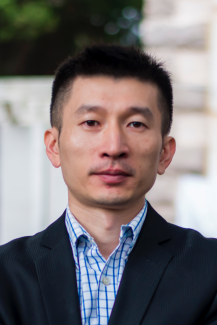
- Tell us a bit about your fall semester course, Machine Learning.
Machine learning algorithms underpin various technological advancements like search engines, fraud detection systems, and large language models, all of which have seamlessly integrated into our daily existence. Our course endeavors to furnish aspiring students with an intuitive understanding and serve as a pathway for their progression into competent data professionals.
In a nutshell, this course is designed to introduce fundamental concepts and technologies forming the basis for those exciting business applications. It encompasses classical supervised and unsupervised methods along with state-of-the-art algorithms, including ensemble learning for structured data, convolution neural networks (CNN) for computer vision problems, transformer models (BERT, GPT) for natural language processing (NLP), and more.
- How do you integrate western and eastern perspectives given the joint nature between Stern and NYU Shanghai of the program?
I strongly believe that the joint nature has the potential to instill critical thinking and foster cultural awareness among our students. We strive to impart different perspectives by incorporating comparative studies of both Chinese and western companies, and I would like our learning to be “glocal” by delving into current events “right here, right now”. Students are encouraged to engage in similar analyses, and guest speakers contribute by sharing best practices from both the US and China. For example, when we discussed the application of logistic modeling, I mentioned both the FICO score and the Alipay Sesame Credit score so that students gain insights into local practices. Later on, when studying pioneering large language models such as GPT-4 and Llama2, students were amazed to learn about Chinese rival chatbots such as Ernie from Baidu.
AI has no nationality, but the contents generated by AI can reflect the cultural influences of creators behind. When we discussed generative AI such as Dall-E 3, students once came across an AI-generated commercial featuring Chinese poem recitation against the backdrop of misty mountains. With our students’ diverse education and national backgrounds, they not only appreciated the distinct eastern aesthetics embedded; they found technology exciting when connected with cultural identity and artistic traditions!
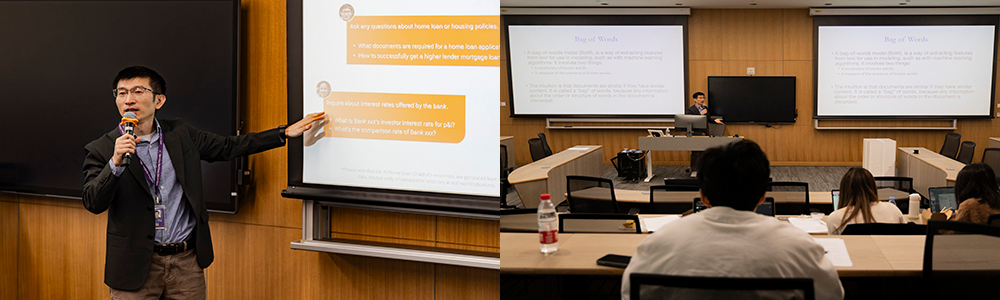
Professor Tim Zheng lecturing in the Machine Learning course
- How is the curriculum tailored to pre-experience (students straight out of undergrad without work experience) Master’s students?
Since machine learning algorithms tend to be abstract and boring, our curriculum starts with an introduction of AI, of which machine learning is a subset. Popular AI tools such as ChatGPT and Midjourney easily connect students with what they are going to learn, making this topic more tangible and imaginable.
Moreover, students acquire new concepts by relating to past experiences. For example, many students have already applied methods like decision trees for classification in their internships, so they find it straightforward when I explain enhanced models such as bagging and random forest in a familiar setting.
When discussing the application of various algorithms, I also put students in the perspective of business leaders and guide them to think about the tradeoffs of a given model (e.g., precision/recall tradeoff). As they come to realize the importance of business implications in interpreting modeling outcomes, they will gradually perceive the nuances of the business world. Furthermore, learning also goes beyond the classroom. Students are encouraged to participate in industry events like the 2023 Global Digital Marketing Summit, an annual conference in China which offers them an opportunity to better understand cutting edge topics.
- Are there other highlights of the Machine Learning course you want to share (i.e. group projects, case discussion, guest speakers, company visits)?
We invited several guest speakers from companies such as Beijing H&T Information Services Company, Uniqlo, and Omnicom Media Group to share best practices and cutting-edge technologies. They offered insights into social media sentiment analysis, and highlighted popular AIGC applications, to name a few. These discussions enhanced students’ academic understanding, as well as inspired them to explore career opportunities in data-driven organizations.
Students enthusiastically engaged in our company visits and gained valuable insights. For example, we recently went to Sensetime, an AI company listed on the Hong Kong Stock Exchange. Witnessing the use of deep learning for cancer diagnosis and autopilot, students swiftly connected real-world applications with machine learning algorithms (e.g., CNN) they learned. By the end of the visit, students were astounded to discover how photos and recordings from public video cameras could be utilized by municipal administration to identify and locate misplaced shared bikes through entity identification!
- How do you integrate your own research or background into the course?
I am intrigued by how businesses utilize data analytics and machine learning models to make data-driven decisions. Leveraging my work and research experience in data science, I crafted a curriculum that integrates foundational machine learning concepts with real-world applications. It also incorporates case studies and examples from my own professional journey, stimulating thoughts about challenges in the business world. As a result, students progressively cultivate an awareness of the distinct skill sets essential for different fields, facilitating informed decision-making for their next stage.
My professional network also made it efficient to invite industry experts to share insights on cutting-edge applications, prevalent industry practices, or lessons learned from modeling experiences, which makes data analytics more practical.
- What are your impressions of the DABC students so far?
Energetic and inquisitive, our students are fast learners. They demonstrated strong interest in machine learning and AI-related topics. Initially, some of them could only work with basic Python packages, but achieved significant proficiency in using complex scikit-learn libraries for their assignments. Although they came from very diverse backgrounds, their efforts to master advanced Python skills paid off in a short period. It's truly inspiring to witness their passion for analytics enabled them to get out of their comfort zone.
What’s equally remarkable is that they never hesitated to connect their learning with critical, modern topics. For example, for the Machine Learning group project, some students chose to apply LSTM and XGBoost to predict the price of Bitcoin (BTC) while some tried random forest and stacking models in a study of the world economy. The unique perspective each individual brought, combined with their eagerness to apply their learning, created a dynamic environment. It’s been an absolute pleasure to get to know this cohort so far this year.
- Tell us a bit about the Capstone course. What is your approach to identifying projects/sponsors, assigning groups, etc.?
This year, we have capstone sponsors from different sectors including advertising, luxury, fast moving consumer goods (FMCG). I aim to work with firms that actively adopt AI and integrate data analytics into their daily operation. We not only focus on B2C businesses which inherently have analytical needs like traditional customer segmentation and response prediction models, but also include B2B enterprises that leverage machine learning methods to comprehend the macroeconomic environment.
The projects cover mixed subjects, such as employing ensemble techniques for macroeconomic forecasting, leveraging generative AI to facilitate marketing automation, and utilizing NLP technologies to investigate how Chinese consumers perceive sustainability. Given their diverse interests, students organically created groups and selected projects aligned with their preference. Through close collaboration with industry mentors, students will undergo a comprehensive loop from hypothesis development to validation. I hope they have fun!