



May 13, 2020
Written by NYU Shanghai Graduate Admissions
In order to better announce the adjustment of the semester arrangement of the Master's program, the Graduate Admissions Office of NYU Shanghai held a Chinese webinar session on the evening of May 13 at 7:30pm. Detailed explanations of the adjustment of the program structure of both MS in Data Analytics and Business Computing (DABC) and MS in Quantitative Finance (QF) were announced to ensure that the students could plan accordingly, as well as to have excellent learning and practical experience.
The event also featured Professor Liao Ming, who is currently teaching in the MS in Data Analytics and Business Computing program. Professor Liao is a visiting professor of Business and Economics at NYU Shanghai, and a senior tutor at the Business Education and Research Center. Currently, he teaches Data-Driven Decision Making and mentors the Capstone Project within the DABC program. His main teaching and researching areas include data science, artificial intelligence, fintech, marketing and advertising.
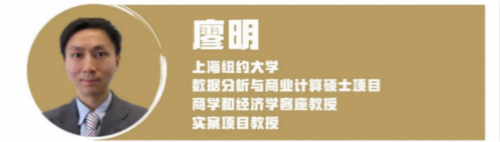
Professor Liao first delivered the speech titled "Data Analysis Skills in the Age of Artificial Intelligence". Taking Facebook, which currently has a market value exceeding 500 billion U.S. dollars, as an example, its core business is based on advertising with more than 99% of income coming from the area. In order to build a good advertising platform, the company studies how to provide good content to an audience of more than 2 billion, and predicts the type of content each individual will be interested in, such as advertisements, sharings, videos or news feed.
So is it a very complicated process to match content with such a huge audience? The answer is no. The core algorithm behind it is surprisingly simple. It is actually a classical Data Science and Machine learning algorithm, e.g., GBDT (gradient boosted decision trees). Our students will also study this type of algorithm once they start the program. Thanks to this core algorithm, Facebook is able to continue to expand its business field: news, videos and photos, e-commerce, automatic translation, virtual reality / augmented reality, non-governmental organizations, gradually building the Past, the Present and the Future of the company.
Among the FANG (Facebook, Amazon, Netflix & Google) companies, what they have in common is to match the content with the audience through machine learning. While In China, famous data technology giants such as Baidu, Alibaba, Tencent, Sina, Byte Dance (known as “BATSB” as a whole) all use artificial intelligence and machine learning as a vital role in their daily operations.
Based on his work experience in leading data-driven and digital transformation areas within the company, combined with his mentor role and teaching experience in various business schools, Professor Liao introduced three competencies that students have to possess: Business Domain Expertise, Computer Science and thirdly, Maths & Statistics).
It is worth mentioning that the DABC jointly offered by NYU Shanghai and NYU Stern is designed based on Data Science, which sits right in the center of the three above-mentioned competencies, to design courses and guide students’ development.
In the Computer Science area, we focus on different programming languages, such as Python, which will be largely used in the courses delivered by Professor Liao. Maths & Statistics, on the other hand, emphasizes on the process of machine learning, such as training the computer to identify a cat, by learning from data.. The nature of artificial intelligence is similar to that of teaching a child to get to know the world. We should not set too many rules, instead, we should allow the machine to observe the real world and then gradually find its patterns.
Artificial intelligence is a very broad concept, while machine learning is a subset, focusing on finding patterns from actual data. In the past few years, a specific type of machine learning, called deep learning, have achieved great progress. Their applications include sales forecasting and personalized recommendation for Ecommerce, stock return prediction and portfolio optimization, housing price prediction, computer vision etc,. With rich industry experience and excellent professional skills, Professor Liao helped students bring the knowledge learned from the textbooks into real world and life scenarios during the Capstone Project.

After the sharing, Professor Liao summarized the emphasis of the DABC program: focus on the business applications, help lay a solid foundation in various fields; at the same time, the knowledge and practice in programming, as well as the exposure to the latest AI and machine learning algorithms, in order to facilitate the students’ learning in many interesting and useful areas.
Q&A:
Is there a chance for the students to try the Capstone Project in the finance area?
Professor Liao: Yes, as a matter of fact, some students from the last cohort worked with a very well-known international financial services company. Also the company provided a very complete database and application scenarios.
Can the program be customized in terms of course options?
Professor Liao & Grace: The program adopts a lock-step curriculum. For students from the MS in Data Analytics and Business Computing who wish to take 1-2 courses from the MS in Quantitative Finance, a background check will be applied. However, the design of the program was previously conducted by the Program Academic Directors and faculty members after multiple discussions, thus the curriculum is quite fixed.
Could you please share your experience of working on the digital marketing project with Unilever?
Professor Liao: Sure. As we all know, Unilever has many shampoos and shower gels products. In the past, one advert would be enough to spread out the words to a large audience. However in the era of digital media, the fact that everyone has individualized needs urges the company to understand exactly the consumer's needs. For example, female consumers may need hair care advice if they are to attend a party. Some students may need to attend job interviews, the questions will then be how to do hair on such formal occasions. At Unilever, we worked on content creation and content distribution for the targeted consumers. In this case, data science played an important role: firstly, to understand the different needs of the consumers; secondly, create personalized content and target consumers.
Do the students need to self-study programming languages such as Python and R?
Professor Liao: I would suggest that our students study both, as they are equally helpful. Students could take some online courses. From my point of view, the best way of learning is through practice, such as participating in a real project. This is also our criteria when designing the curriculum. We prefer to give students a specific case, rather than simply teaching the content in the textbook.
Can students self-study Machine Learning, without any previous exposure/experience?
Professor Liao: Of course. If you don’t have previous knowledge, we also have foundational courses in Machine Learning built into our curriculum, which include statistical data analysis and predictive models. We will definitely make sure that a good foundation is laid for the students.
Given the new adjustment of the program structure, will changes also be made to the Capstone Projects?
Professor Liao & Grace: The Capstone Project will run throughout the major part of the program. The current idea is to start the Project in China, as it will be divided into several stages. Students will first get in touch with the client and try to understand their needs through business analysis and analytical modeling. Our clients are mainly based in China, so the students will have sufficient time to communicate with them, as well as collecting data. After getting into analytical modeling in the United States, students could still continue with the project and keep in contact with the clients despite the time difference.
The DABC program is a joint effort of NYU Shanghai and NYU Stern. Will there be any differences in terms of the Capstone Project?
It’s basically the same, including basic principals and the understanding of business, technology and programming. However, there will be differences in specific cases: when in China, the students will be more involved with the local market, including company visits to Bytedance, Shanghai Big Data Center, Amazon, etc.; while in the US, we will go to American software companies . In my classes I will invite reputable companies from the industry, such as Alibaba, Unilever, and Ping An Technology to share industrial insights.
In response to the global impact of the epidemic, the project directors and professors adjusted the curriculum and the course structure after many rounds of thoughtful discussions. Grace then shared the latest updates and application requirements. Both DABC and QF will start on August 3 at NYU Shanghai. Students will then attend the third semester in mid-February 2021 at Stern School of Business to complete the entire program; they will also graduate in New York. Although the total length of the semester has been reduced, the course is more compact and the vacation time will be reduced accordingly.
It is worth sharing that NYU Shanghai has recently re-opened. The campus has also adopted strict protection measures to ensure the safety of the teachers and students on campus.