



June 2, 2020
Written by NYU Shanghai Graduate Admissions
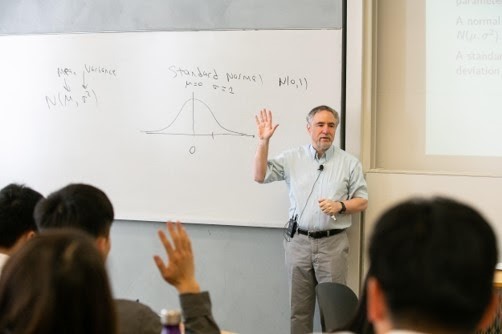
To help the Class of 2020 admitted students better understand the NYU SH-Stern MS programs’ curriculum and recent program updates, the Graduate Admissions Office held the second faculty series webinar on May 20th. The event featured MS in Data Analytics and Business Computing program director Prof. Jiawei Zhang, MS in Quantitative Finance program director Prof. Jeffrey Wurgler, and Assistant Director of NYU SH-Stern MS Programs, Nina Wineburgh. Program directors and Nina shared their insights about the updated curriculum design, the adjustments of different courses, and the advantages of experiential learning. They also provided suggestions to the incoming students to be better prepared academically prior to the start of the program.
Program update
Nina Wineburgh:
As you may have noticed, the schedule for Class of 2021 has been changed. Students will start at NYU Shanghai in early August, and will spend August through early February at NYU Shanghai. Students will head to Stern for the last semester of the program, starting in mid-February until the end of May. We announced this change a few weeks ago, which was based on our priority to make sure that students can learn in person since the NYU Shanghai campus recently reopened.
Students can begin the program in person at NYU Shanghai and then finish up in New York at Stern. More detailed information about the academic calendar is accessible to you in your AAdmitted SStudents PPortal.
For the MS in Data Analytics and Business Computing curriculum and MS in Quantitative Finance curriculum, you can see that the courses have not changed from what we originally planned even though we changed the calendar of it. The only significant change is that the Capstone Project is going to start a bit earlier. So it will start in the fall at NYU Shanghai and it will go through the end of May,, through the end of the program.
How do you think the DABC/QF program is unique?
Jiawei Zhang:
Joining the DABC program, students will study in both global financial centers: New York and Shanghai. Students will interact with very talented faculty who have not only a strong academic background but also years of industrial experience. For instance, professor Liao Ming, who will teach two courses, Statistics and Data Analysis and Advanced Machine Learning, held senior positions in Facebook, Nielsen, etc.He is not only an expert in Statistics and Machine Learning, but also an expert in digital marketing. Besides the faculty, some of the courses we offered are quite unique, such as Network Analytics. With faculty conducting cutting-edge research in this area, students can comprehend important topics more in depth. Finally, in terms of curriculum design, the capstone project should be highlighted. Building a strong tie with advisors and senior executives in companies such as JD, Pingan, Dangdang, our faculty can receive feedback about the curriculum design and adjust details accordingly.
Jeffrey Wurgler:
First of all, the locations across global financial centers are of great importance for the QF program. This enables students to be familiar with some of the world’s most important financial market areas. Different from the MBA curriculum, our program tries to provide a high-level, broad yet deep introduction in the one-year study with exceptional in-depth study on mathematical and statistical techniques. Moreover, the small and intense classes enable students to build their lifelong networks.
Adjustments of the Curriculum Design
Jiawei Zhang:
For the DABC program, the curriculum is the same as last year in terms of the content. Four courses about the data modeling skills will be delivered, followed by two courses about decision modeling skills. The third cluster of courses is business application oriented. What’s more, we provide courses concerning soft skills for better communication, collaboration, and presentation.
For the sake of career opportunities and the job interviews, we arrange courses for students to learn data modeling skills and programming skills to build up their competitiveness. By the end of October, students can finish these courses and be ready for the interviews. And the Capstone Project is scheduled in early November, leaving enough time for students to connect potential employers and present their achievements.
Jeffrey Wurgler:
Due to the unexpected situation, we have rearranged the curriculum and reversed locations of experience, but the education content remains the same as before.
How do you recommend students get prepared for the program in the following months?
Jiawei Zhang:
For students who may not have prior programming skills, I recommend them to gain some basic knowledge about programming, especially with R, which can help them focus on more advanced topics after the class begins. We offer an introductory course on python programming.
Jeffrey Wurgler:
We expect students to have a high level of technical preparation in order to handle the coursework well. Students are encouraged to develop R and Python skills on their own, which are very helpful in future careers.
How is experiential learning incorporated into the curriculum of the program?
Jiawei Zhang:
We organized company visits first, and students have abundant chances to see how companies, like American Express, Amazon Joint Innovation Center use technologies and Data Analytics to generate value. Students learned a lot through company introductions and speeches delivered by company executives. What’s more, several courses assign course projects for students to apply their knowledge in real practice, addressing interesting real-world issues. Finally, Capstone Projects need students to work with company partners to solve real-life problems, during this process their technical skills and soft skills will be practiced. One capstone project this year is to collaborate with a multinational bank in Shanghai and identify high value customers from credit card transaction data. Thus, students are provided with many opportunities to learn and to practice.
Jeffrey Wurgler:
Likewise, for the QF program, we also have company visits and guest speakers. This year, we had capstone projects sponsored by board members of the MSQF Program. A portfolio company of Kohlberg Kravis Roberts sponsored two projects. These are more technical commodities forecasting. Students need to use a wide range of data from macroeconomic and other factors to provide models to predict commodity prices. Wells Fargo also sponsored two projects. The students needed analytical techniques to provide models or new approaches to target customers for certain kinds of products. In all of these projects, students had frequent interactions with company executives.
Q&A:
For the Data Analytics and Business Computing program, which one is more important? Domain expertise or the technical skills?
Jiawei Zhang:
I think they are equally important. Our program is not a data science program but a data analytics one. We focus on how students apply data science models to solve problems through the business lens. Domain expertise helps data scientists understand business challenges and build better models.
Which courses in the Quantitative Finance Program will train programming skills?
Jeffrey Wurgler:
Unlike the DABC Program, we don’t directly offer the courses to train particular skills. But there are case-by-case considerations, and we strive to help students meet individual goals.